
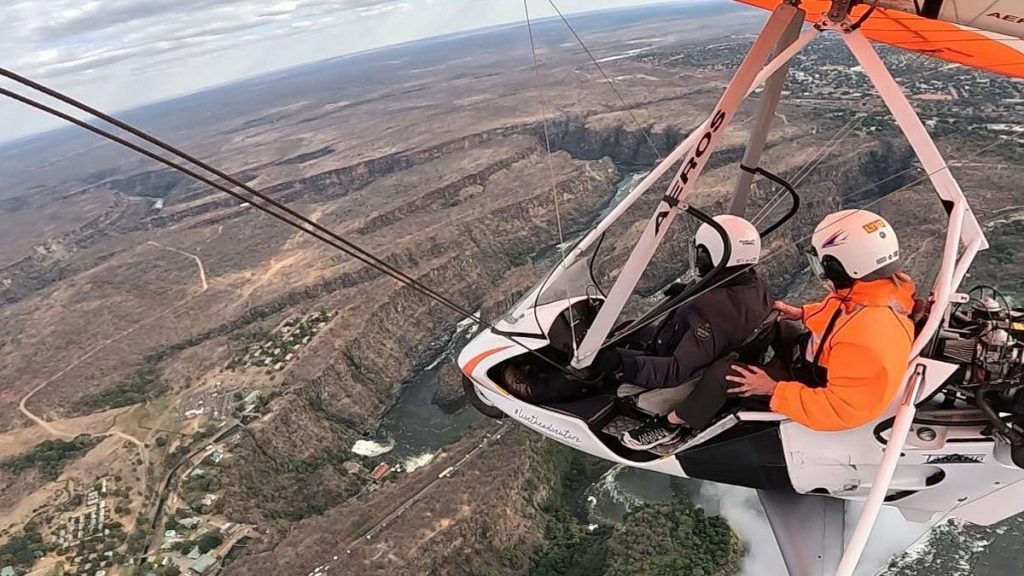
When most people think of flying, they picture a familiar sequence of events: stepping into a pressurized aluminum tube, sitting behind thick layers of plexiglass, listening to the distant hum of jet engines, and watching a motionless landscape crawl beneath them from 35,000 feet. It is efficient, comfortable, and undeniably impressive. Yet, for all its technical marvel, commercial aviation and even standard general aviation tends to isolate the passenger from the medium of flight itself. You are not truly in the sky; you are inside a room moving through it.
Microlight flying, often known as ultralight aviation, completely flips this dynamic on its head. Stepping into a microlight cockpit is less like boarding a vehicle and more like strapping on a pair of mechanical wings. If conventional flying is like watching a nature documentary on a high-definition television, flying a microlight is like diving headfirst into the wilderness. Here is why taking to the air in a microlight feels fundamentally different from anything you have ever experienced in a traditional airplane.
Unfiltered Sensory Immersion
The most immediate shock for first-time microlight pilots and passengers is the absolute exposure to the elements. In an open-cockpit flex-wing microlight (often called a weight-shift trike), there are no doors, no side windows, and no climate control systems.
You feel the wind pressing against your jacket, the dramatic shift in air temperature as you climb through thermal currents, and the distinct scent of pine forests, wet earth, or salt air carried up from the ground. Every subtle shift in atmospheric pressure becomes a physical sensation rather than a needle moving on a dial. You do not simply observe the weather; you interact with it directly. This raw sensory input creates an adrenaline-fueled sense of speed and immersion that an enclosed cabin simply cannot replicate.
The Illusion of Zero Velocity vs. Pure Tactile Motion
In a commercial airliner cruising at high altitudes, visual cues of speed vanish. Looking down at clouds or distant ground features makes you feel almost stationary. Traditional light aircraft, while lower and slower, still offer a smoothed-out experience where flight control surfaces damp down the sensation of movement.
Microlights fly significantly lower typically between 500 and 3,000 feet above ground level—and at much lower airspeeds, usually between 35 to 80 knots. At this altitude, the ground moves beneath you in vivid, three-dimensional clarity. You can spot wildlife tracing paths through fields, wave at farmers, and follow the exact contours of winding rivers. Because the air frame is lightweight and responsive, every pocket of air provides instant tactile feedback. You feel the physical reality of aerodynamic lift in real time.
Physical Intuition: Weight-Shift vs. Aerodynamic Controls
In a conventional aircraft, controlling the flight path is an exercise in indirect input. You turn a control yoke or push a stick, which moves hinged surfaces (ailerons, elevators, and rudders) at the trailing edges of the wings and tail. Hydraulic systems or cables transfer your movements, and the plane responds.
While three-axis microlights use controls similar to standard planes, flex-wing microlights operate on weight-shift control a mechanism far closer to hang gliding. To bank left, you physically push the control bar to the right, shifting your body weight and the pod beneath the wing. Pitching down to gain speed requires pulling the bar toward your chest. This creates a deeply visceral, intuitive connection between pilot and wing. Flight stops feeling like operating a machine and begins to feel like an extension of your own body physics.
Unmatched Panoramic Visibility
Cabin pillars, instrument panels, low-slung wings, and small side windows severely limit what you can see from a conventional airplane seat. You spend much of the flight peeking through framed viewports.
In a microlight, your field of view is virtually unrestricted. With no structural nose cone blocking your forward vision and no cabin walls to the side, you enjoy a panoramic 360-degree view of the horizon. The ground drops away directly beneath your boots. For aerial photography or simple sightseeing, this unobstructed vantage point provides a breathtaking sense of freedom that cannot be matched by standard aircraft designs.
Grass-Roots Aviation and Simplicity
Conventional aviation comes with layers of complexity: extensive pre-flight checklists, complex avionics, strict air traffic control corridors, and long taxiways at major airports. While these systems ensure high-level safety, they also shift the focus toward procedural management.
Microlighting strips aviation back down to its pure, romantic origins. Operating from short grass strips, farm fields, or quiet rural airfields, microlights require minimal infrastructure. The aircraft themselves feature simple, air-cooled engines and streamlined instrument clusters. Pre-flight checks are hands-on, straightforward, and focused on basic mechanical integrity. This simplicity removes the bureaucratic weight from flying, allowing pilots to focus entirely on the joy of airborne motion.
Reconnecting With the Fundamentals of Air
Ultimately, flying in a conventional aircraft highlights humanity’s ability to conquer the environment through technology, insulating us from the harsh realities of altitude and wind. A microlight does the exact opposite: it demands that you harmonize with nature.
Every thermal bubble, sea breeze, and terrain-induced draft is something you feel, respect, and utilize. It returns flight to its foundational essence a bare-bones, heart-pounding dance with the sky that reminds you precisely why humans dreamed of flying in the first place.