
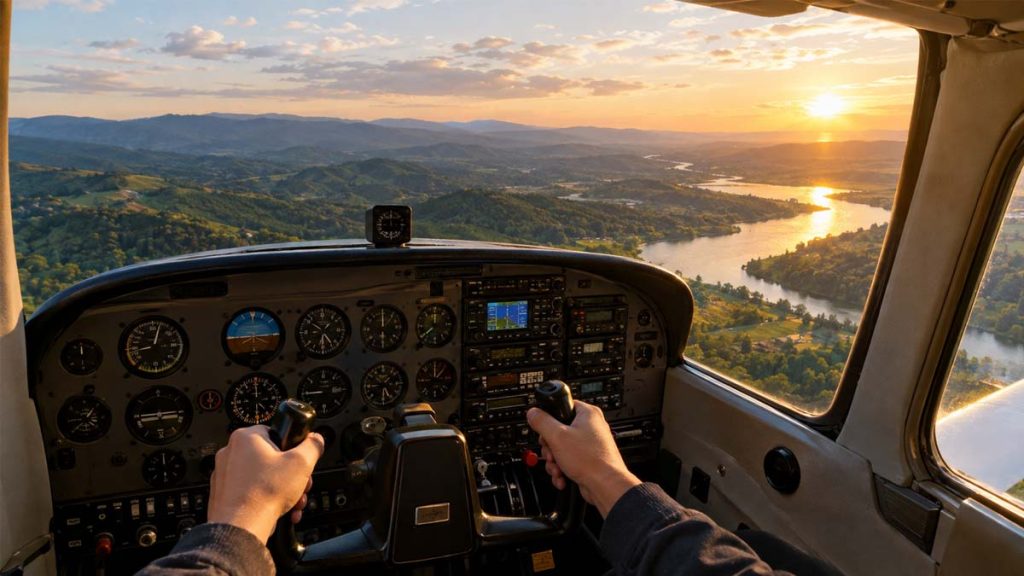
For anyone who has ever dreamed of taking the controls of an airplane, the first few hours in the cockpit are nothing short of transformative. You’ve read the ground school manuals, memorized airspeeds, and perhaps spent hours on a flight simulator. But nothing quite prepares you for the raw, sensory-rich reality of actual flight.
When student pilots take to the skies for their introductory lessons, a flood of unexpected sensations and realizations instantly reframes how they view aviation. Here are the most common—and often surprising—things new pilots notice during their first few hours in the air.
1. Flying Is Remarkably Physical
Most people imagine flying as a delicate exercise of steering with two fingers, much like driving a modern car on a smooth highway. The reality of a light training aircraft (like a Cessna 172 or Piper Archer) is far more physical.
New pilots are often surprised by the amount of force required to move the control yoke or stick, especially when fighting against airflow at higher speeds. Furthermore, the rudder pedals—used to control the aircraft’s yaw—require deliberate leg work. By the end of a flight lesson, many students realize they’ve had a modest upper-body and core workout just keeping the wings level.
2. You Don’t Steer on the Ground Like a Car
Before you even leave the ground, your brain gets its first shock during taxiing. In a car, turning the wheel changes your direction. In most training aircraft, turning the control yoke while on the taxiway does absolutely nothing to steer the airplane.
Instead, steering on the ground is done entirely with your feet using the rudder pedals. Pushing the left pedal turns you left; pushing the right pedal turns you right. To make matters more mind-bending, pressing the tops of those same pedals applies the left and right brakes. Overcoming years of driving muscle memory is often the very first hurdle a student faces.
3. The Horizon Is Your Primary Instrument
In movies, pilots are always staring intensely at a dashboard full of glowing screens and spinning dials. In reality, during your first few hours of Visual Flight Rules (VFR) training, your flight instructor will constantly tell you: “Get your eyes outside!”
New pilots quickly realize that the natural horizon is the best attitude indicator available. Pitching the nose up or down is measured by how many fingers of space exist between the top of the dashboard (the dashboard cowl) and the real horizon. Learning to fly by visual reference outside the cockpit—feeling the plane and looking at the landscape—is one of the most liberating early lessons.
4. The World Looks Completely Different from 2,500 Feet
We are used to seeing the world from ground level or from the high-altitude window of a commercial airliner at 35,000 feet. Flying in a general aviation aircraft at 2,000 to 5,000 feet provides a uniquely intimate perspective on the terrain.
- Landmarks stand out: Highways, rivers, and powerlines become primary navigation tools.
- Topography comes alive: You notice subtle elevation changes, valleys, and ridges in your hometown that you never knew existed.
- Wind becomes visible: You see wind patterns in the ripples of lakes, the drift of smoke stacks, and the movement of tree lines.
5. Turbulence Is More Like Washboard Roads Than Falling
Non-pilots often fear turbulence, associating it with dramatic movie scenes where planes plunge thousands of feet. In a light aircraft, student pilots quickly discover that routine thermal turbulence feels less like falling and more like driving over a bumpy, unpaved dirt road.
As the sun heats the earth, warm air rises in columns called thermals. Passing through these columns creates tiny bumps. Once new pilots learn that these bumps are completely normal—and that the airplane naturally wants to stay stable—the fear quickly melts into fascination.
6. Trim Is Your Best Friend
In the first hour, holding the nose at a constant pitch angle requires continuous pull or push pressure on the yoke, which quickly tire out a student’s arms. Enter trim.
The trim tab is a small adjustable surface on the elevator that neutralizes control pressure. Instructors constantly preach, “Trim for speed.” The moment a new pilot learns to trim the aircraft properly, the yoke stays right where they want it without constant muscle exertion. Realizing you can let go of the yoke and watch the plane fly perfectly straight and level is a major “aha!” moment.
7. Radio Communication Feels Like a Foreign Language
Listening to Air Traffic Control (ATC) for the first time is notoriously intimidating. The rapid-fire delivery of callsigns, runway assignments, altimeter settings, and taxi instructions sounds like a completely different language.
During the first few hours, students realize that speaking on the radio requires its own mental bandwidth. Learning the NATO phonetic alphabet (Alpha, Bravo, Charlie) and the standard structure of radio calls (Who you are calling, Who you are, Where you are, What you want) takes deliberate practice, but mastering it is a major point of pride.
The Journey Begins
Those first few flight hours are an intense sensory experience filled with rapid learning curves, physical adjustments, and moments of pure awe. While the technical demands can feel overwhelming at first, the feeling of trimming the aircraft, looking out at the horizon, and realizing you are flying the airplane is an experience no pilot ever forgets.